

Contents
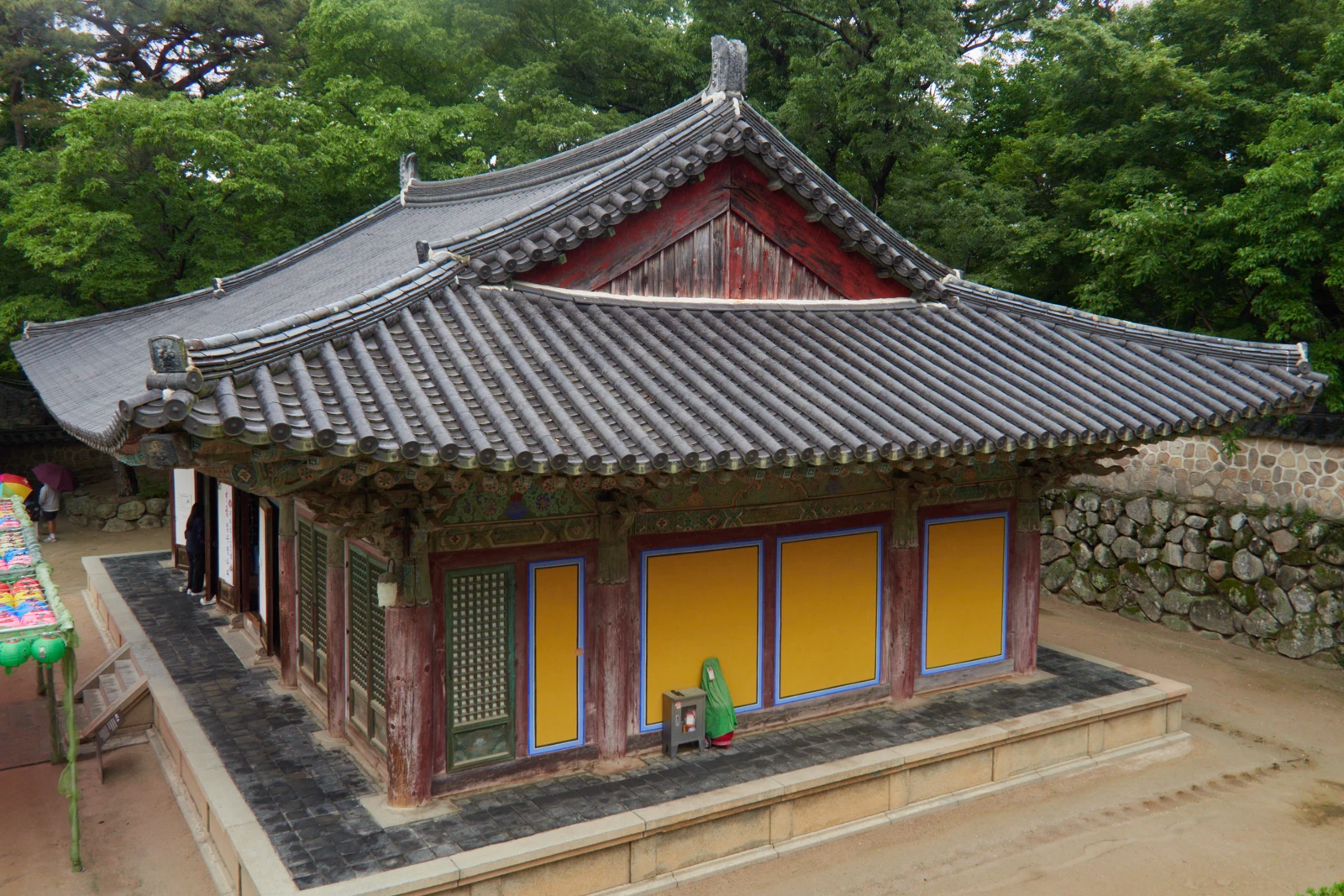
A temple best explored through its architecture
Bulguksa rewards a slower look at stone terraces, the courtyard before Daeungjeon and the contrasting Dabotap and Seokgatap pagodas. Allow an estimated 90–120 minutes inside, excluding transport, meals and Seokguram.
Bulguksa and Seokguram share a 1995 World Heritage inscription but have separate entrances and require a mountain transfer. With only half a day, a complete temple visit can be more rewarding than rushing both.
Admission and opening times in 2026
Ordinary temple admission is free. Old 6,000 won admission figures should not drive your budget. The museum, parking and special experiences are separate items.
The city’s March 2026 page lists 09:00–18:00 with last admission 17:00, while seasonal temple information differs. Plan a morning or early-afternoon visit and confirm the date’s admission cut-off on the temple visitor information and entrance notices. Check Seokguram separately if continuing uphill.
Spring blossom and autumn foliage can increase queues and parking pressure. Summer calls for shade breaks and winter for care on wet stone. The terraces, pagodas and halls remain worthwhile outside peak flower or leaf conditions.
Getting there: distinguish the current KTX station
Use your accommodation or the intercity bus terminal as the downtown origin and 불국사 as the destination. The city’s older sightseeing guide mentions routes 10 and 11, but it does not independently establish the complete current stop pattern. Check the day’s connection through the Gyeongju traffic information centre.
Older guides mentioning Gyeongju Station may mean the former downtown station, not today’s KTX station. An older tourist map shows 711, but a July 2026 city notice rerouted station services including 711. Do not rely on the old mapped alignment; search from the current KTX station to Bulguksa for your travel date. If dropping luggage at a hotel, plan from that hotel instead.
The bus stop still leaves an approach walk. Store large luggage before visiting rather than pulling it over temple paths. For a group, compare taxi cost with waiting time; save 불국사 and 불국로385, and arrange the return separately.
Read the stone terraces before entering the courtyards
From outside, study Cheongungyo, Baegungyo and Jahamun, then the neighbouring Yeonhwagyo, Chilbogyo and Anyangmun. The bridges and stairs express a transition between the lower space and the sacred precinct above. A broad view explains the arrangement better than only a close-up.
Photograph the complete terrace, then move sideways to compare stonework, timber gates and overlapping eaves. Use designated visitor access; historic stairs and fenced areas are not climbing props. Include the supports and pavilion around Beomyeongnu in your observations.
When groups arrive, read signs off the main passage and wait for a brief clear view rather than occupying the centre. Separate wide compositions from stone details. Bright stone and dark eaves can create strong contrast, so adjust phone exposure for the building rather than the sky.
Compare Dabotap and Seokgatap in one courtyard
The courtyard before Daeungjeon is the visit’s centre. Dabotap stands to the east with elaborate stairs, railings and geometric layers; Seokgatap to the west has a restrained three-storey silhouette. Begin with both in one view, then examine their details from permitted positions.
Their pairing refers to the Lotus Sutra: Dabo Buddha bears witness to Shakyamuni’s teaching. They are therefore more than unrelated ornaments. Look at the shared court, compare the towers and turn back towards the hall.
Relic objects and the Dharani sutra discovered during work on Seokgatap connect the temple to printing, craftsmanship and conservation. Consider the Bulguksa Museum if those subjects interest you, checking current displays, original-versus-replica status and admission separately.
Choose your extension through the halls
At Daeungjeon, observe the roof, columns and court before entering any worship space under its posted rules. Keep voices low around worshippers and follow instructions concerning Buddha photography, flash and restricted areas.
Geungnakjeon provides another focus, with Museoljeon, Birojeon and Gwaneumjeon possible extensions. Steps between precincts make map distances misleading. With older companions, complete the main court first and decide whether the upper areas are comfortable.
Wheelchair and stroller users should ask the temple about accessible entrances and the day’s usable route. Vehicle access does not establish access to every hall. If splitting up, choose a recognisable meeting point and time.
Continue to Seokguram or return downtown
Before leaving Bulguksa for Seokguram, confirm uphill and return transport and decide where lunch fits. The mountain journey is a separate excursion. Long waits, motion sickness or poor weather can make a different time more suitable.
Alternatively, return to the Gyeongju National Museum or reserve Donggung Palace and Wolji Pond for the evening. This combines religious architecture, artefacts and royal landscape without repeating the same experience. Day-trippers from Busan should fix their return transport before committing to night views.
A Busan-departure heritage tour can reduce transfer work. Check the selected itinerary for Bulguksa, Seokguram and Donggung and Wolji, as well as stop lengths; a product title does not guarantee that every option visits every named site. Independent travel offers more control over time at the pagodas.
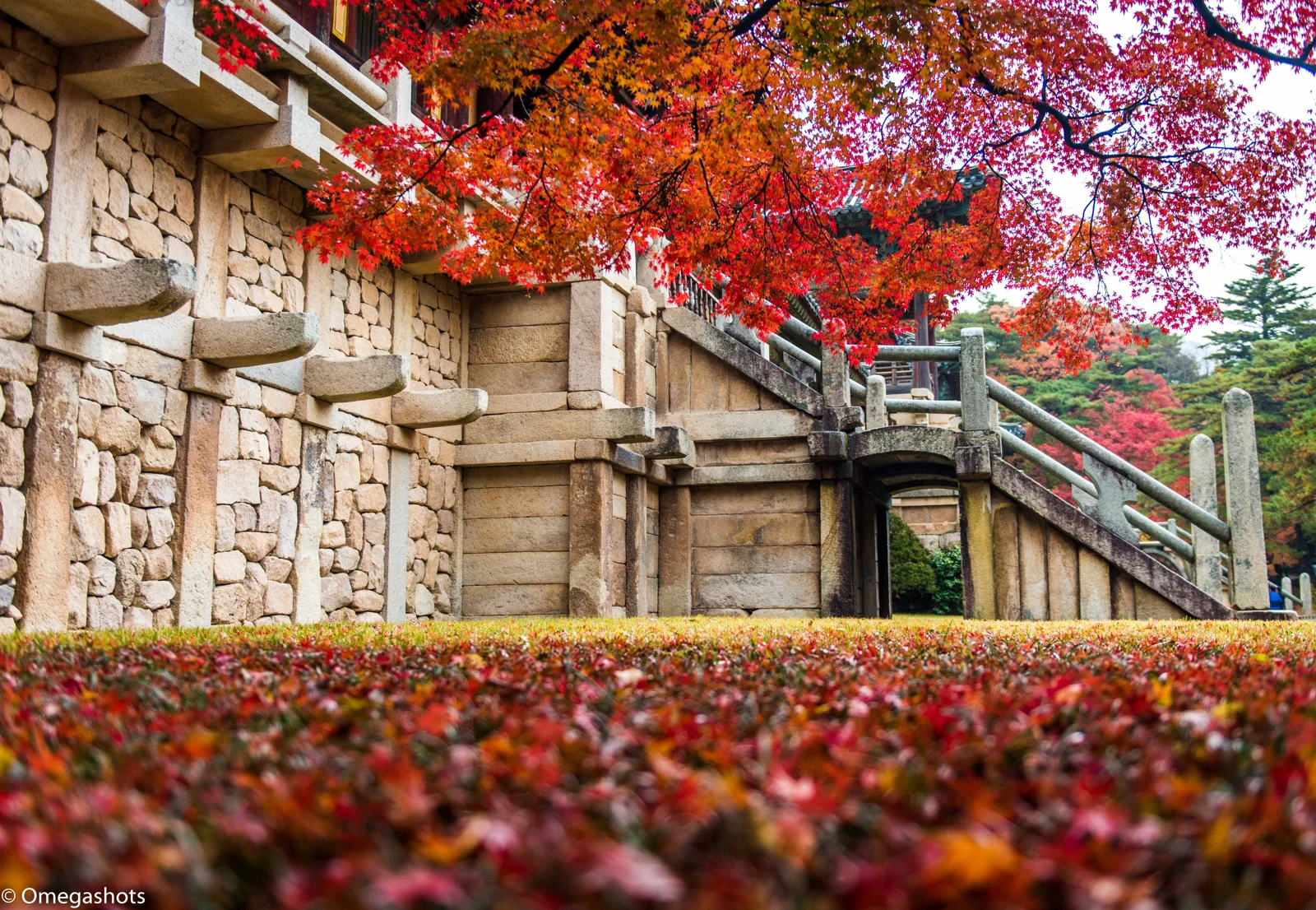
Autumn at Bulguksa: foliage framed by stone and timber
Licence & attribution
Bulguksa works especially well when you look at trees together with rooflines and stone terraces. Rather than treating it as a single forest panorama, move through the permitted approach and courtyards, noticing how autumn color changes the scale and texture of the architecture. The two pagodas remain worth your attention even on a day when the leaves are less dramatic.
Different trees change at different speeds. Golden ginkgo and red maple foliage are distinct subjects, and a forecast for another mountain is not a measured peak date for Bulguksa. Use current temple and Gyeongju visitor information to refine a 2026 trip, keeping the weather and return transport in view.
Continue to Seokguram or preserve time for downtown?
If foliage is your priority, finish the temple walk before deciding on Seokguram. The grotto is a separate excursion with uphill transport, waiting and walking. After a long photography stop, returning downtown for a meal, a museum or Donggung and Wolji may be more relaxed than forcing another mountain visit.
Travelers coming from Busan also need to budget for the transfer between the current Gyeongju railway station and the temple. A high-speed train arrival is not an arrival in the historic center. Protect your return connection first, then decide what fits. Staying in Gyeongju gives the temple a more flexible half-day block.
Keep to open visitor routes. Do not climb closed historic stairs or cross ropes for a photograph. Worshippers and conservation take priority over a foliage composition. Wet stone can be slippery; a shorter, comfortable route can still reveal the relationship between the autumn trees and the temple’s architecture.
Frequently asked questions
Is Bulguksa free in 2026?
Ordinary temple admission is free. Museum entry, parking and experiences are separate.
How much time should I allow?
Estimate 90–120 minutes for the main temple, excluding transport, meals and Seokguram.
Can I rely on old directions for buses 10 and 11?
Use routes 10 and 11 as a starting point, then check your boarding stop, direction and Bulguksa connection in the city transport system. Do not treat route 10-1 as interchangeable with 10.
Is the KTX station the station in old guides?
No. The former downtown station and today’s KTX station are different locations.
Can I combine Bulguksa and Seokguram?
Yes, with separate time for mountain transport, waiting, walking and each site’s admission deadline.
Where are the two pagodas?
In front of Daeungjeon, with Dabotap east and Seokgatap west.
Can I climb the historic stairs for photographs?
Follow the open visitor route and never cross barriers onto closed heritage structures.
What works after the temple?
Without Seokguram, return to the National Museum and consider Donggung and Wolji in the evening if your return transport allows.
Must I add Seokguram to a foliage visit?
No. A temple-focused day gives more time for walking, photographs and rest.
Do maples and ginkgo peak together?
Not necessarily. Species and position affect color, and one photograph is not a live report for the whole temple.