

Contents
Haedong Yonggungsa belongs in an eastern Busan day. Plan the return journey and the stairs first, then choose between a relaxed temple visit and adding Gijang attractions such as the luge or coastline. The seaside setting is distinctive, but this remains an active place of worship. Leave time to look at the sea, observe respectfully and rest, rather than treating every staircase as a photo stop.
Allow enough time for the setting
Temple roofs above a rocky shoreline give Yonggungsa a very different feel from a mountain temple. Make it a main stop if your interests include architecture, worship or watching waves. If your companions want only rides and dislike stairs, discuss whether combining such different activities is worthwhile. A stop everyone is willing to experience slowly is more rewarding than repeatedly hurrying people back to a vehicle.
Allow roughly one to two hours around the temple and entrance area, plus transport. This is a flexible planning allowance for photographs, pauses and worship. A journey from central Busan also involves transfers, waiting and the walk after the bus. If you have a fixed train or flight later, plan backward from the return deadline rather than treating coastal-road travel as a short, perfectly predictable journey.
General temple admission is free. These are private Busan tour options, not temple tickets. Check whether your selected route includes Yonggungsa, where pickup operates and how long the stop lasts.
Separate admission from visiting hours
General admission is free. Visiting hours are 04:30–19:20, with last admission at 18:50. Free admission does not include parking, food, souvenirs or separately purchased experiences. If visiting near opening or closing, confirm arrangements with the temple before committing to a long journey that might end in a rushed exit.
Daylight is the simplest choice for ordinary sightseeing, especially with older companions or children. Last admission does not mean every area will remain available until the final minute. Follow any changes associated with worship, weather or maintenance. Save the address and contact details from the temple travel-information page so you can check them again while traveling.
| Plan | Advantage | Allow for |
|---|---|---|
| Temple-focused visit | More time for worship and sea views | The full return journey |
| Temple plus luge | Two eastern experiences | Eligibility, lunch and queues |
| Temple plus theme park | Same regional cluster | Less time inside the park |
From Haeundae, the bus is only part of the trip
From the Haeundae area, use a live map to find a bus toward the Yonggungsa entrance and allow for the walk after the stop. Confirm the service and destination rather than assuming every bus uses the same stopping point. Translated stop names vary, so search 해동용궁사 and check the boarding direction in your map app. A matching bus number alone does not establish direction, and the bus stop is not the temple’s main-hall doorway.
After the bus, follow the signed approach and allow for crossings, orientation and breaks. Arriving at Osiria Station on the Donghae Line still leaves a final leg to the temple entrance; reaching Osiria is not the whole trip. Choose connections according to your accommodation, service timing and walking ability. Public transport can reduce cost, while a taxi mainly reduces the number of transfers.
Independent travel versus an organized tour
With the temple and one or two nearby stops, independent travel preserves your own pace and makes weather-related changes easier. A tour or private vehicle can simplify a multi-stop day, especially across different parts of Busan, but it does not remove the distances involved. Compare stop lengths, meeting points and the return time rather than judging value by the number of attractions in a sales description.
When comparing private Busan tours, check whether the selected route includes Haedong Yonggungsa. Read the selected package rather than relying on the overall title. Check guiding language, pickup, meals and attraction-ticket inclusions. If quiet worship is your priority, favor sufficient time at the temple over a route that spends most of its day moving between distant sightseeing areas.
Think about the return before descending the stairs
The 108-step approach deserves thought if you are traveling with older companions, young children or anyone with mobility needs. Going down may feel easy, but the return requires climbing. Consider knee comfort, stride and rest needs before starting. If someone may not complete the route, agree on appropriate waiting, meeting and turnaround points beforehand rather than negotiating in the middle of the stairs.
Do not assume a stroller can reach every coastal worship area, or judge wheelchair access from photographs. Contact the temple with your equipment and actual requirements if a step-free route is essential, then decide on the visit after confirmation. Large luggage makes stairs and passing crowds harder. Store it elsewhere when possible and carry a small bag; having a hand free for a railing matters more than one extra piece of camera equipment.
Make room for worship and ordinary movement
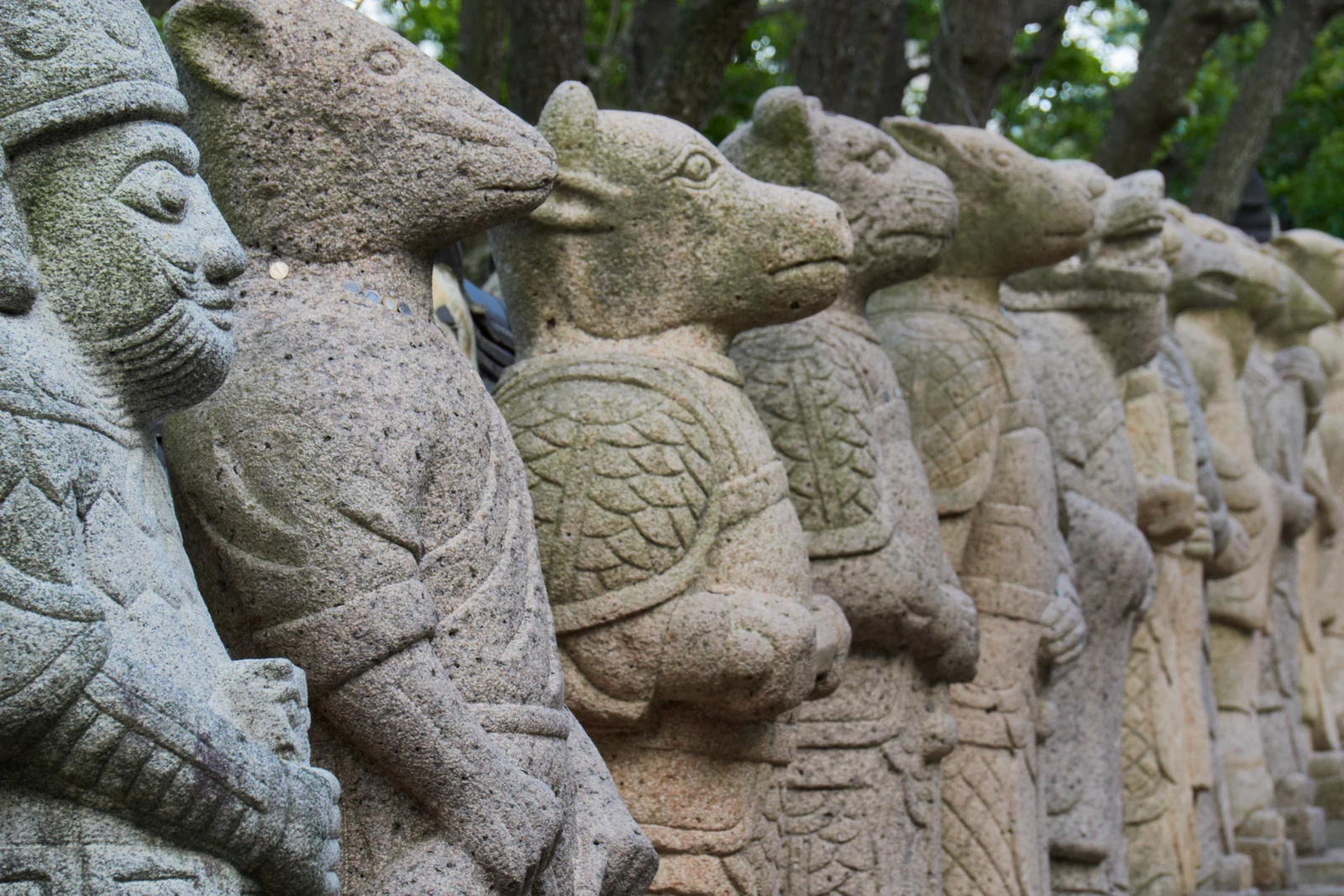
Read the main route as zodiac figures → Iljumun Gate → the 108 steps → Yongmungyo Bridge → Daeungjeon Hall. Find your zodiac animal near the approach, then follow the pine-lined descent as the sea gradually enters the view. The bridge leads into the main temple area. The appeal lies in that changing relationship between trees, rocky shore and buildings, rather than simply reaching a final photo spot. Complete the main route before choosing a couple of views to revisit.
Useful signs are 대웅전 for Daeungjeon, 해수관음대불 for the sea-facing Avalokitesvara statue, and 용문교 for Yongmungyo. Reaching the statue area involves another climb for a higher view of the temple and sea, not a step-free shortcut. Architecture-focused visitors can linger around the halls and courtyard, while coastal-view visitors can use the open shore-side route for rocks and waves.
Sunrise, rain and wind need different plans
The difficult part of a sunrise visit is often transport and light levels, not camera settings. Check seasonal sunrise, entrance availability and a workable outward and return journey. A daytime bus route does not prove pre-dawn service. If the plan requires unfamiliar stairs in darkness or leaves the return uncertain, visiting after sunrise still provides the coastal setting without the same pressure.
In rain or stronger coastal wind, prioritize traction and balance over photographs. Umbrellas occupy space on crowded steps, so wear and carry things that leave your hands usable. Dramatic waves are not an invitation to move closer; respect every closure. When changing the plan, remove optional coastal walking first and preserve a straightforward exit and return rather than waiting until everyone is soaked to consider alternatives.
Add one main Gijang attraction
For the luge, give the temple and rides their own morning and afternoon blocks, with a proper meal and transfer between them. Luge eligibility involves height, age and health, while the temple involves stairs. Being in eastern Busan does not make both suitable for every companion. If a child cannot ride or an older traveler prefers not to climb, agree on waiting arrangements or alternatives before buying tickets.
If Lotte World Busan is the main event, give it most of the day and add the temple only if you genuinely want to trade away some park time. Temple, luge, theme park and Sky Capsule should not be treated as adjacent one-hour slots without queues. Before adding a final café, check your return direction and remaining transport. A comfortable eastern itinerary usually leaves stronger memories than forcing four landmarks into one day.
Frequently asked questions
Is admission paid?
General admission is free; parking and purchases are separate.
What address should I use?
Use 86 Yonggung-gil, Gijang-gun, Busan, or 해동용궁사.
Does the train reach the temple?
No. A final connection or walk remains after the station.
How many steps are described?
The approach includes 108 steps; allow energy for the return.
Can a stroller complete the whole route?
Do not assume so; stairs and access between areas require advance checking.
Are buses guaranteed for sunrise?
No. Check the date, first service and return separately.
Can I photograph inside halls?
Follow the posted rules at each hall and avoid disturbing worship.
Can I combine it with the luge?
It can work as two main eastern stops, after checking eligibility, queues and transport.
For accommodation and the rest of your Busan trip, see where to stay in Busan, a three-day Busan itinerary.