
Contents
Choose where you want to return each evening
For a first trip focused on palaces, shopping and central sights, start with Myeongdong/Euljiro and Jongno/Insadong. Put Hongdae first when cafés, shopping and nights out are the point of the trip. Move your base south of the river when work or events repeatedly take you to Gangnam. No district is the most convenient for everyone: recurring journeys matter more than the single transfer that looks easiest on arrival.
Before comparing rooms, list three non-negotiable destinations, your latest evening activity, and your departure station or airport. Map these against each hotel’s actual entrance. This is more useful than searching for a universally best Seoul hotel. A property marketed as Myeongdong may sit closer to Myeongdong Station or Euljiro 1-ga; a Gangnam address can still leave you commuting to your exhibition venue.
Quick area comparison
| Area | Best fit | Main trade-off |
|---|---|---|
| Myeongdong/Euljiro | Central sightseeing and shopping | Different stations, lines and street conditions |
| Hongdae/Yeonnam | Nightlife and AREX All-Stop | Large station and the final hotel approach |
| Jongno/Insadong | Palaces and traditional streets | Exact station and hanok room arrangements |
| Seoul Station | KTX and airport rail | Station side and daily sightseeing routes |
| Gangnam/COEX | Southern commitments and exhibitions | Gangnam is not one compact location |
| Jamsil | Lotte World-led family days | Repeated trips to northern sights |
Use the area comparison above to narrow your search, then compare Seoul hotels. Check the station exit, room occupancy, total price and cancellation terms; these options may be in different neighbourhoods.
KlookMyeongdong and Euljiro: start here for a central itinerary
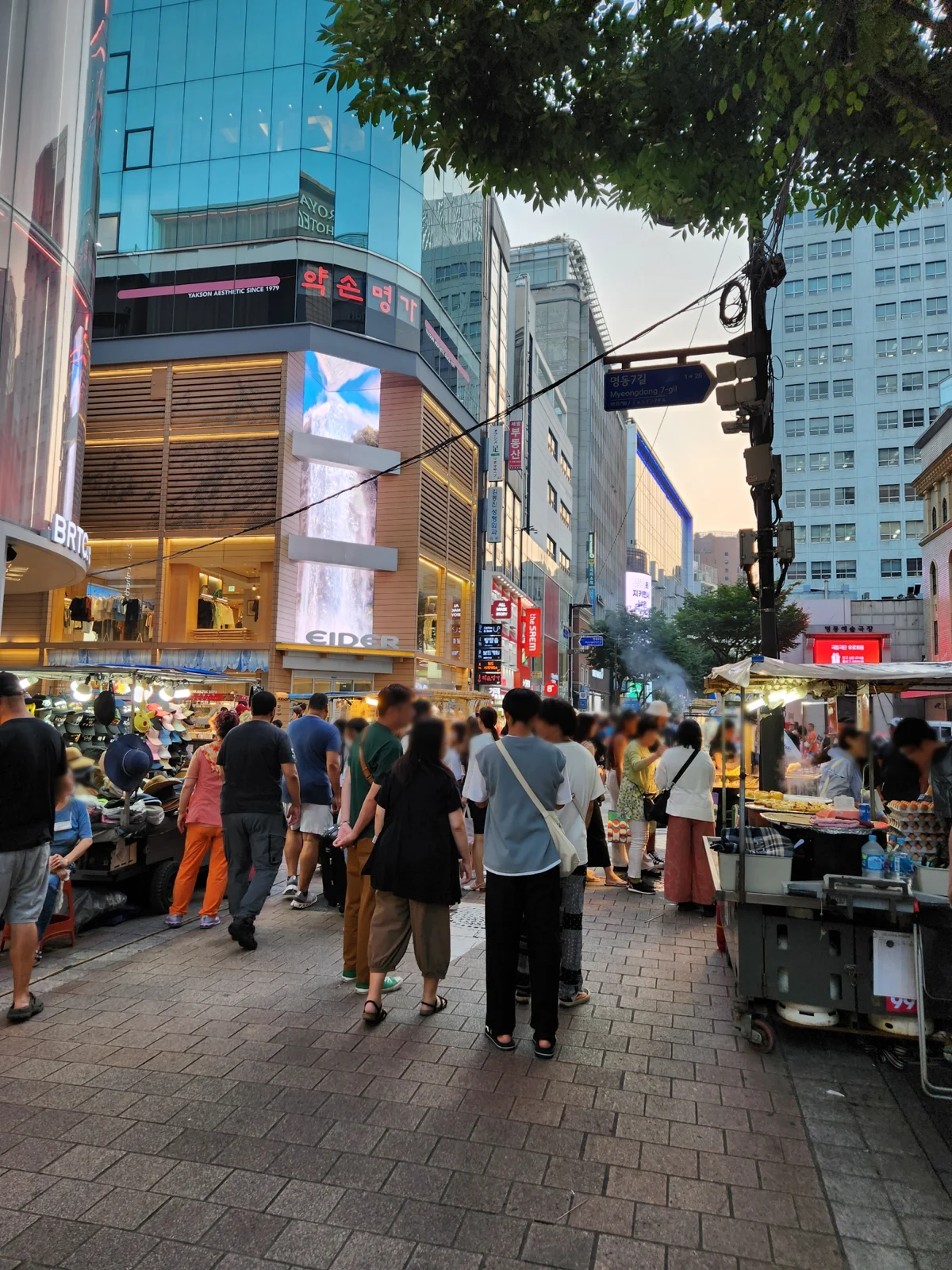
Myeongdong works well when shopping, meals and sightseeing are interspersed with returns to your room. You can leave evenings relatively unplanned and still have a shopping district around your base. For first-timers or companions with different interests, that flexibility can outweigh a photogenic room. A busy commercial location does not mean every side street is noisy, but check the room’s outlook, recent noise reviews and its relationship to pedestrian traffic.
Myeongdong Station and Euljiro 1-ga are different stations: the former is on Line 4, the latter on Line 2, while Euljiro 3-ga farther east is another interchange. Booking sites often group them under one neighborhood label. Compare the Euljiro 1-ga side for repeated Line 2 trips, including Hongdae, and Line 4 options when Seoul Station is important to your onward journey. Judge the hotel entrance and useful station exit rather than its marketing area.
Hongdae and Yeonnam: nightlife with useful airport access
Hongdae lets shopping, music and dinner continue around your base rather than end with a cross-city journey. Pop culture, independent music and evening activity give the area plenty to explore after dinner. If most nights out are here, staying locally reduces the pressure to leave for the last train. Nevertheless, assess soundproofing, nearby bars and weekend activity property by property; neither Hongdae nor Yeonnam is uniformly loud or quiet.
The AREX All-Stop train calls at Hongik University Station; the Express runs between Incheon Airport and Seoul Station without calling at Hongdae. That distinction matters more than a vague “near AREX” description. Hongik University is a substantial interchange, and movement between platforms and exits still takes effort. A Yeonnam or inner-Hongdae address is not automatically beside the station. With heavy luggage, check the elevator exit and the final street-level approach.
Jongno, Insadong and Gwanghwamun: a cultural base
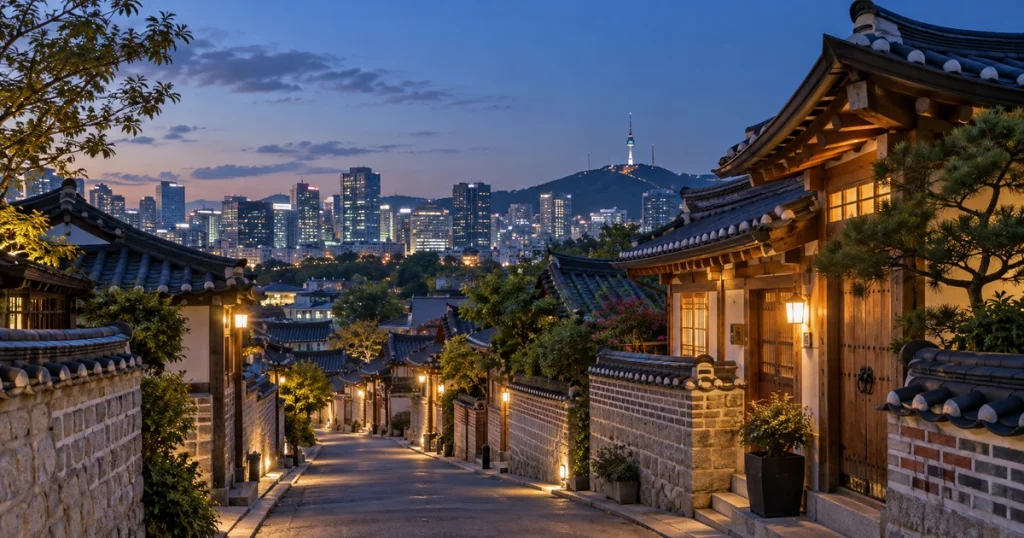
For palaces, traditional neighborhoods, tea houses and museums, place Jongno, Insadong and Gwanghwamun on your first shortlist. This does not make every attraction walkable; it aligns your base with the theme of your days and avoids starting each outing by crossing the city. Insadong’s tea houses and galleries provide an alternative to building every afternoon around shopping.
The labels cover a broad area: properties near Anguk, Jongno 3-ga and Gwanghwamun suit different routes. Treat a hanok stay as a specific accommodation product, not an automatic family recommendation based on appearance. Confirm beds or floor bedding, private bathroom arrangements, acoustic privacy, luggage handling and reception hours. For older relatives needing elevators or children needing naps, prioritize the room and return route over the building style.
Seoul Station: useful for rail travel, with an important last leg
Seoul Station is worth considering when KTX travel, the airport railway and your Seoul stay need to work together, particularly around a short stop or a luggage-heavy departure. “Near Seoul Station” does not mean the hotel faces your platform. The side of the station, underground passages and major roads all affect the last leg. Recheck the walking route from the entrance you will actually use; straight-line distance from a station pin is a poor luggage metric.
Do not let one easy arrival decide five or six nights without considering subsequent dinners, shopping and sightseeing. Add those journeys before deciding whether a transport-led base is worthwhile. Seoul Station’s city-airport check-in has airline, flight and train eligibility requirements. It is not a universal benefit for everyone staying nearby; verify your specific flight before relying on it.
Gangnam, COEX and Jamsil: choose the right southern cluster
Travelers often use “Gangnam” for a broad southern area, but Gangnam Station, Samseong/COEX and Sinsa are distinct bases. For repeated COEX visits, compare the hotel-to-venue entrance route rather than merely filtering for Gangnam-gu. Conversely, a contemporary-looking southern hotel can be a poor fit for days dominated by Gyeongbokgung, Insadong and Myeongdong if it adds repeated river crossings.
Jamsil is a good candidate when Lotte World, the mall or nearby plans anchor the trip. The theme park, mall and aquarium are in Jamsil, but not every local hotel is connected to the complex. Families should test whether returning to the room after an outing is straightforward, then verify occupancy limits, child pricing and breakfast rather than booking solely because the district has a family-friendly label.
Narrow the choice around how you travel
With young children or older relatives, identify the most important daily sightseeing cluster and seek a straightforward return journey. The busiest interchange is not necessarily the easiest base. Wheelchair users, stroller users and travelers with large luggage should verify step-free access all the way from station exit to hotel door. Ask the property about the exact accessible room and bathroom; a district label or star rating cannot establish suitability.
For two or three nights, one base usually works better when nearby sights are grouped into the same day. Consider splitting a longer trip only when it has clearly separate northern and southern phases, and count packing, luggage storage, transfers and another check-in. On a tight budget, compare less central streets within a suitable district before moving to the outskirts. Include additional daily transport and potential late-night taxis in the total price.
Nightlife affects the next morning as well as the journey home. When some companions want late shopping and others want an early night, a clear route back within the same district can allow different schedules. Cold winter days or summer rain make street approaches and transfer passages more consequential, so treat weather as a normal planning factor. Even if you expect to use taxis daily, check the pickup location and luggage capacity rather than assuming every alley permits convenient loading.
Turn “near the station” into a practical booking check
Ask five questions: which exact station and line serve the hotel; whether the useful exit has an elevator or requires a detour; whether a suitable return service remains after your evening plans; whether reception and check-in accommodate your arrival; and whether luggage storage works with your final day. These answers are more informative than a “five-minute walk” without clearly defined endpoints.
Compare the same dates, occupancy and cancellation conditions, including taxes, breakfast, bedding and children in the booking. Scenic-room marketing will not shorten a commute; prioritize the right location, sleep conditions and room configuration. Check transport and prices for your actual dates, especially around early flights, late arrivals and major events, rather than assuming an ordinary-day journey applies.
Plan the airport journey to your hotel
Frequently asked questions
Myeongdong or Hongdae for a first visit?
Compare Myeongdong/Euljiro for palaces and central shopping. Hongdae is a stronger fit for evenings there and useful All-Stop airport-rail access. Let your repeated destinations decide.
Does the AREX Express stop at Hongdae?
No. Use the All-Stop train for Hongik University Station. The Express runs between Incheon Airport and Seoul Station. Check your hotel’s useful station before buying a ticket.
Are Myeongdong and Euljiro 1-ga interchangeable?
They are separate stations on Lines 4 and 2 respectively. The side of the district where you stay affects daily routes and airport transfers.
Must families stay in Jamsil?
No. Jamsil merits comparison for a Lotte World-led trip. For palaces and central sightseeing, a northern base with an easy return to the room may be more practical.
Does staying at Seoul Station guarantee city check-in?
No. Eligibility depends on the airline, flight, timing and train requirements, not the hotel address.
Is Gangnam ideal for daily palace visits?
Assess the repeated river crossings. For mostly northern sightseeing, compare Myeongdong, Euljiro or Jongno first; Gangnam becomes more useful with recurring southern commitments.
How many nights justify changing districts?
There is no fixed threshold. A single base usually simplifies a short trip. For a longer trip with distinct geographic phases, compare travel saved against the cost of moving.
Does metro proximity mean step-free access?
No. Verify the specific exit, street approach, hotel entrance and room facilities. Ask the hotel to confirm the step-free route when needed.